Awful offal, I assume, includes heart, liver, lungs, animal’s entrails, plus tails, feet, and heads. This practice or custom of preparing offal dishes may (or may not) be a reflection of a culture’s economy and resourcefulness.
When we were young, Dad maintained a poultry farm in our backyard and distributed dressed chickens to wholesalers and neighbors. So just imagine offal overload. Our meals were full of chicken parts – not only the prime and choice parts. Think of adobong paa ng manok, chicharong isaw ng manok, chicharong balat at taba ng manok, dinuguan using chicken blood. (Chicken feet cooked in vinegar, salt, garlic, pepper and soy sauce, chicken chitlin/skin/fat cracklings, chicken blood stew.) The best would be adobong atay at balunbalunan – the most widely eaten lamang loob. A lot of people say that in chicken nothing is wasted. But of course, not everybody likes what it offers. I for one wouldn’t dare touch a chicken head. I’ve tried it and I don’t wanna ever look back though I would lovingly go to the nearest dim sum restaurant for chicken feet.
So it was like our meals were full of chicken feet than we ever wanted – adobong manok with adidas (dish cooked in vinegar, salt, garlic, pepper and soy sauce), tinolang manok with adidas (ginger stew), fried whole chicken complete with adidas. You name it we had it that for years I couldn’t bring myself to eat chicken until I was about 16. The chicken feet? Till the time I discovered dim sum in my early 20s.
Source: My Childhood Food Memories
I’m not one of those who stay away from offal dishes though I seldom cook such as I tend to be the only one who enjoys ‘em. Lasang Pinoy 9, hosted by Cia over at Pabulum, is all about lamang loob or innards and again I was tempted to buy the intimidating chitlins (check out my adobong isaw for LP6) but decided to cook the less controversial chicken liver instead. Chicken liver steak – mala bistek. (Read: Too busy with work I have no time to go to a decent supermarket to buy ingredients.)
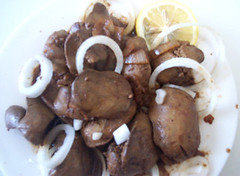 Bistek is a Filipino-style beef steak typically made with strips of sirloin beef cooked in soy sauce, calamansi juice and onion rings. Sometimes we substitute beef with pork while using liver makes a good appetizer. Here’s how I did mine as I remember it the way my sister cooked it the last time she visited me here in Beijing.
Continue reading “LP9: Pinoy-Style Chicken Liver Steak”

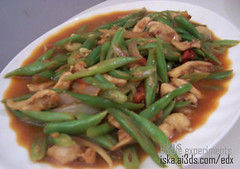 Here is a stir-fry recipe that is neither Chinese nor Filipino but a combination of both. Chinese stir-fry veggies normally have ginger and thick sauce while I grew up with ginisang sari-saring gulay (mixed vegetables) with tomatoes and no ginger. Mom’s gulay guisado is never about high heat and meat is always cooked longer. So, I took out the ginger, retained the tomato flavor and cooked it the way I love Chinese stir-fry dishes – the thick sauce and of course, how fast we can prepare a meal this way.
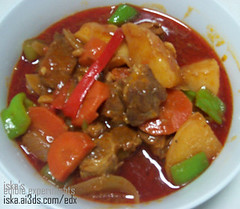 I seldom get requests from readers about a recipe.
 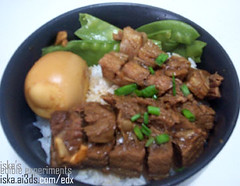 What I had in mind actually is beef pares. This is already my 2nd attempt and my official tagatikim (food taster) thought what I did here is very similar to the one served in our favorite restaurant back home. Still we believe a stronger flavor would do the trick. My guess is star anise. I purposely omit it as we don’t really like too ‘Chinese’ tasting dish but I will definitely stir it in next time. I was also lazy to add in cornstarch to make thicker sauce so for the meantime, I will call this dish simply beef toppings. The hard-boiled egg in the photo? Well, I felt like I wanted to add some in the stew.
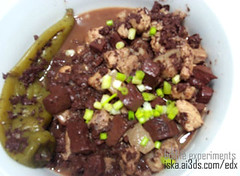 I know I just had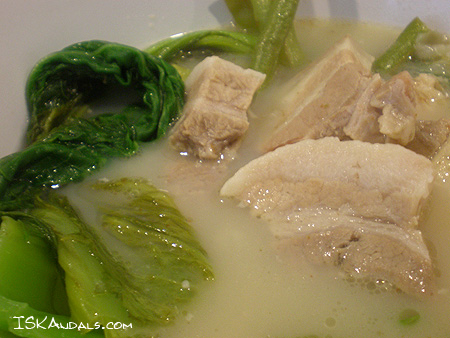
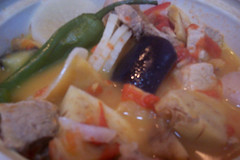 I’ve always wanted to post a pork sinigang recipe but my ingredients are perpetually incomplete. It’s the weather that’s driving me crazy like kangkong (river spinach) isn’t available during winter or that I couldn’t find a single decent gabi (taro) during the summer days. Either I missed out buying the green chili or I am just plain unlucky.
 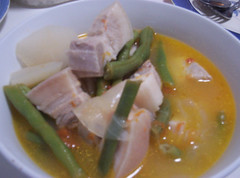 So I decided to post what I have and present few pics all at the same time…
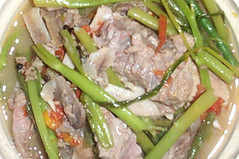 The vegetables that I normally include in the broth are sitaw (string beans), kangkong, radish, okra, aubergine, mustard greens and gabi. I don’t necessarily put everything all together but there are few combinations that I really like. I also love gabi as it gives a thick and creamy texture. I like crisp sitaw and kangkong. I like crushed tomatoes in it. I like okra but too bad i can’t find them here. One more thing, I like it real sour but not astringent. Hindi yung basta naasiman lang.
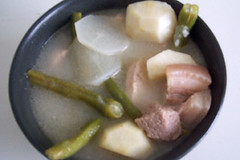 Here is the recipe for the 1st photo shown above. 2nd photo shown is sinigang without gabi, aubergine and green chili pepper but with sitaw. 3rd photo is buto-buto (bony parts) with sitaw and kangkong. Notice the color of the soup when it has no tomatoes as shown in the last photo.
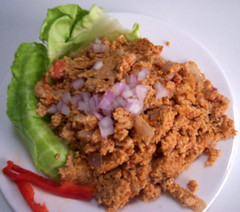 On my way to pick up my son from school this afternoon, I passed by a supermarket, bought lapu-lapu (grouper) and saw this pack of fresh fish roe. (I believe they are grouper roe.) I thought instantly that fish offal also qualifies as lamang loob so I bought few grams and decided to make another
 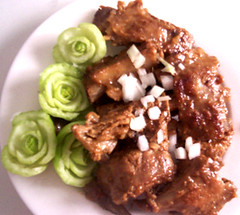 I’ve been experimenting with Chinese cooking wine lately since I found a bottle in a supermarket a month ago. So far it’s a hit! This was lunch last Easter Sunday. Those green roses are actually the bottom part of pechay where the stalks meet. We didn’t eat ‘em. They just look pretty next to the spareribs.
 Happy Easter! So busy with giving a fresh new look to our HS class website (using