 My chosen field is said to be a man’s world. Back in college where one interacts with more males and t-squares than females, important and close friendships between opposite sexes is as natural as breathing. And after each semester of hard work and sleepless nights, breaks and summer vacations were celebrated with parties full of booze. (Parents, no need to worry. As long as you know who your kids’ friends are there is no reason to panic.)
The 1st time we had a drinking spree at home was my 19th birthday and that day marked the beginning of a series of inuman either with friends and relatives. My parents were always there enjoying every bit – mom drinking liters of cola while dad with just half a bottle of beer that’s consumable for the whole night.Social drinking eventually played a huge part in my kind of work for a lot of reasons. Dealing with colleagues, clients, consultants, suppliers, contractors, even laborers. Also like Ting said, drinking is a way of unwinding. It’s a person’s way of de-stressing from a hard day’s knock although now it’s been quite a while since I went into such a pinoy-style gathering and my tolerance to alcohol has diminished considerably.
Pulutan is a kind of food that is served as accompaniment to a drink. It comes in different kinds like meat, fish, nuts, chips. It’s prepared in different ways… fried, steamed. Basically, it is anything that makes drinking enjoyable.
 Too bad I forgot what Dad & Mom normally prepared for pulutan. My guess, menudo or inihaw na tilapia (broiled tilapia over live charcoal). With my friends, I do remember that isaw has always been a favorite. It could be IUD (chicken intestines) from a street vendor (IUD photo is courtesy of GUTS. GRIT. GUMPTION.) or crispy chitterlings as prepared by my friend’s mom. Here in Beijing we occasionally go to this English bar with Pinoy musicians, an equally Pinoy chef, and among our favorites are sisig (a sizzling dish of spicy chopped pork head & liver) and chicharong baboy (pork rinds).
However, when it comes to pulutan it’s the other way around over here as it is alcohol that accompanies food. The Chinese traditionally drink while eating so you can imagine the scenario as it’s considered improper to say no to the host especially if he’s our Client. Gan Bei! ( Pronounced ‘gam bay’, meaning ‘dry cup’) You are expected to empty the glass. The good thing is that drinking with food decreases the rate of alcohol absorption and may also reduce the amount consumed.
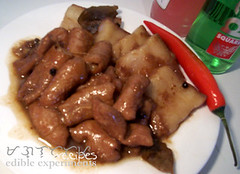 For LP6, here is the recipe of our carinderia adobong isaw ng baboy (stewed chitterlings, chit’lins or pork intestines, whatever) as I remember it from my Dad. It’s not standard turo turo (eatery) food but a delicacy especially popular with the common masses served as pulutan. Oh was I glad to find that the chitlins being sold here in supermarkets are really clean.
Continue reading “LP6: Adobong Isaw”

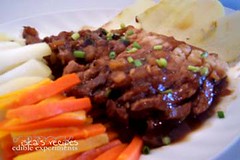 I checked my stats and the most visited pages are my hamonado recipes followed by sinaing na tulingan, patatim, tocino and skinless longgonisa. My hamonado is actually not ham-cured; like my tocino, it has no curing processes whatsoever to preserve food such as standard longganisa, ham, fish, cheese, sausage, or vegetables. It is just a term my dad uses when referring to a big chunk of meat stewed with sweetener for hours. Frankly, I cook this hamonado at least once a month, of course with variations. It is, for me, like adobo – a versatile dish. I use chicken or pork or even beef. Sweeten the meat with fruit juice like pineapple juice, fruit cocktail syrup, pineapple chunks, apples, raisins or just plain sugar. Serve it with steamed vegetables – potatoes, carrots, beans, snowpeas, or even tomatoes, whatever is available. Don’t be surprised if I tell you I have quite a number of pictures waiting to be published.
 Tonight is the eve of the
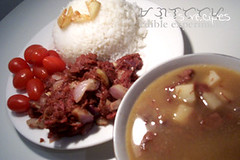 What else am I going to miss? Corned beef. When Ate (my sis) was here autumn last year, I told her we couldn’t find corned beef in Beijing so she gave me some in packets to bring back here. Now we’ve finished the last packet. Sobs! On the other hand,
 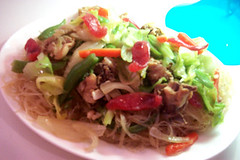 Pancit bihon and
 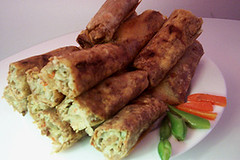 We were so busy thinking about buying our son another birthday cake so we can have our private ‘blowing candle’ celebration. Private meaning just the 3 of us. He already had 1 with our family back home and another one w/ his classmates on his 1st day of school this year. We were almost done w/ eating the cake after an afternoon stroll at the Chinese military museum when I realised it is actually somebody else’s birthday! Good thing I had some party stuff to cook. Lumpiang shanghai and

 I’ve been based in another country since ’93. If I am not mistaken, I have had about 6 to 7 Christmases spent away from home. Before Cean was born, I would say all those Christmases are the worst I knew in my life. Imagine this scenario: I would always put up a happy face and take refuge in the comfort of strangers but after all the fun and I was nested alone within the confines of my square bedroom that would be the time when the reality of not being with my family sets in, tears were shed while calling my mom until exhausted enough to fall asleep.
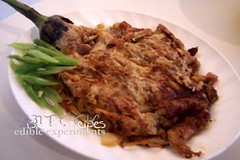 I seldom cook meatless tortang talong (aubergine or eggplant frittata) for the reason that I might be the only one to eat it. And yes, I do cook it for myself to enjoy (and others like adobong atay, burong mustasa and nilagang talong) while preparing another dish for the rest of my family. Back home, our torta is always meatless – just the aubergine and the egg and their glorious taste. (Adobong atay – chicken or pork liver cooked in vinegar and spices, burong mustasa – fermented or just simply salted mustard leaves, nilagang talong – boiled aubergine.)
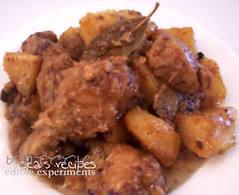 Mom’s chicken adobo is dry. She lets the sauce dries up and fries the chicken w/ more soy sauce. I love it. It’s really good paired with plain rice. But what I usually prepare now is something different. It’s a combination of mom’s adobo ala-eh style and what I encountered during my overnight stays on friends’ homes during my college days. Oh my near-bohemian archi student days. Some of my friends’ moms cook it with thick sauce and potatoes. And oh by the way, 2 non-Pinoy friends of ours – a local Chinese MA student and a Singaporean Spa Owner/Consultant, love our Philippine adobo.
 Just one of those days when we are rushing for a lot of things and don’t wanna have rice for lunch…